
For most of the history of data centers, the building came first. A developer found land near customers and fiber, designed a hall, and then asked the utility for a connection. The power was assumed to follow.
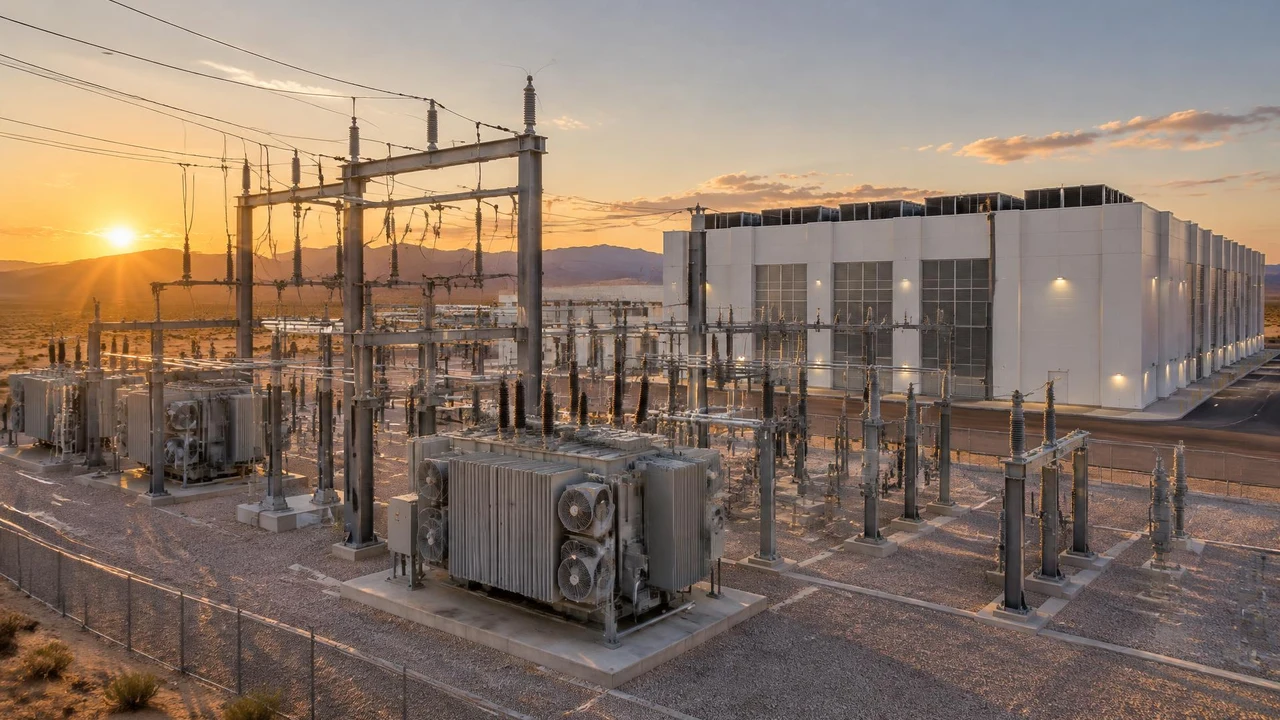
AI has reversed that order. High-density AI campuses need large, continuous loads, and those loads have to be secured before anything else. GPU availability alone does not create deployable capacity: grid access, development land, thermal design and sovereign alignment increasingly determine where AI infrastructure can scale. That is why we describe our work as power-first development. For AI infrastructure, power decides location.
This article explains what that means in practice, and why it changes the sequence of a data center program.
The old sequence no longer works
In constrained global hubs, demand is running ahead of delivery. Interconnection queues can extend across multiple years, and land, permitting and generation constraints vary by market. A beautifully designed building on a site without a confirmed connection is not capacity. It is a waiting room.
The consequence is simple: schedule certainty depends on a verified utility pathway. If the power is not confirmed, every date that follows it in the program is an assumption.
What "power-first" actually means
Power-first development starts with the question every other decision depends on: can power be reserved for this load, at this site, on terms that work?
Answering it means confirming five things before the building design is fixed:
- Capacity: how much power is available, now and in future phases
- Voltage: the level it is delivered at, which shapes the substation and electrical design
- Phasing: how capacity can be released as the deployment grows
- Connection works: the substations, switchgear and lines required, and who builds them
- Commercial terms: the supply arrangements, whether through grid interconnection and power agreements, PPAs or direct substation feeds
Only once these are known can the campus be sized and sequenced properly. The building then follows the power, not the other way round.
From utility power to productive compute
A power-first program treats the whole chain, from utility connection to the rack, as one system. We deliver every site as one integrated build: substation to rack-ready hall.
That chain has several links, and each one has to be sized for the load it serves:
- Grid and substation. The grid connection, substation and critical distribution that bring utility power onto the site.
- Critical power. Switchgear, standby generation and the redundancy topology, with N+1 or 2N options selected against workload tolerance, maintenance strategy and the investment case.
- Rack power. Busway, protection and distribution coordinated with the client's nominated rack and cluster topology.
Because AI and HPC deployments require power and cooling to be engineered as one interdependent system, the thermal design is set alongside the electrical design, with an upgrade path that anticipates changing rack architectures. We cover the cooling side in more detail in our article on liquid cooling for AI racks in desert climates.
Designing for the ultimate state
Power-first does not mean building everything at once. It means knowing the end state before the first phase begins.
A repeatable block strategy can phase investment while preserving the common infrastructure required for the ultimate site capacity. In practice that means planning shared power, water and fiber for the final campus, and protecting land, utility corridors and setbacks for it, even if the first phase uses only part of them.
Each phase should produce a defined information set for the next investment decision. That way, capital is committed in steps, and each step rests on confirmed facts rather than forecasts.
Why the UAE suits a power-first approach
AI infrastructure follows available, dependable power. The UAE combines near-term capacity, development-ready land and a national mandate for sovereign AI, with access to a strong, expanding power grid suited to large, continuous loads. Where land and utility capacity are confirmed, that can translate into a potential speed advantage over constrained markets.
Those are general market observations, not a promise about any specific utility, tariff, approval or site. Every opportunity still has to be qualified through technical, legal and commercial diligence. Power-first is the discipline that makes that diligence come first.
Power-first in practice: Project HyperGrid
Our next project, Project HyperGrid, shows the approach. It is a phased power and data center platform that launches with Bitcoin mining hosting on a grid-connected site in the UAE, then expands to new sites and hosting for AI compute. New facilities are planned around the power and cooling needs of AI infrastructure, and the electrical and cooling design can be adapted from mining to AI workloads over time.
The order matters: the grid-connected site came first, and the facilities are being designed around it.
Questions to ask before you commit to a site
If you are planning an AI deployment, these questions will tell you quickly whether a site is power-first or building-first:
- Has utility capacity been confirmed for the full load, or only for the first phase?
- What voltage is the supply delivered at, and who builds the connection works?
- How will capacity be phased, and on what commercial terms?
- What redundancy topology does the workload need?
- Is land and utility corridor space protected for the ultimate campus?
How we can help
Neoverse designs, builds and hosts high-density facilities for AI compute in the UAE, and coordinates the land, power and hardware each deployment depends on. Our capabilities cover the full chain, from grid interconnection to integrated testing and handover.
If you need power and shell ready for your own fit-out, see our powered shell model. If you want a facility engineered around your rack architecture, see build-to-suit.
Request a turnkey RFP and bring your load plan. We will help build the path to power.