

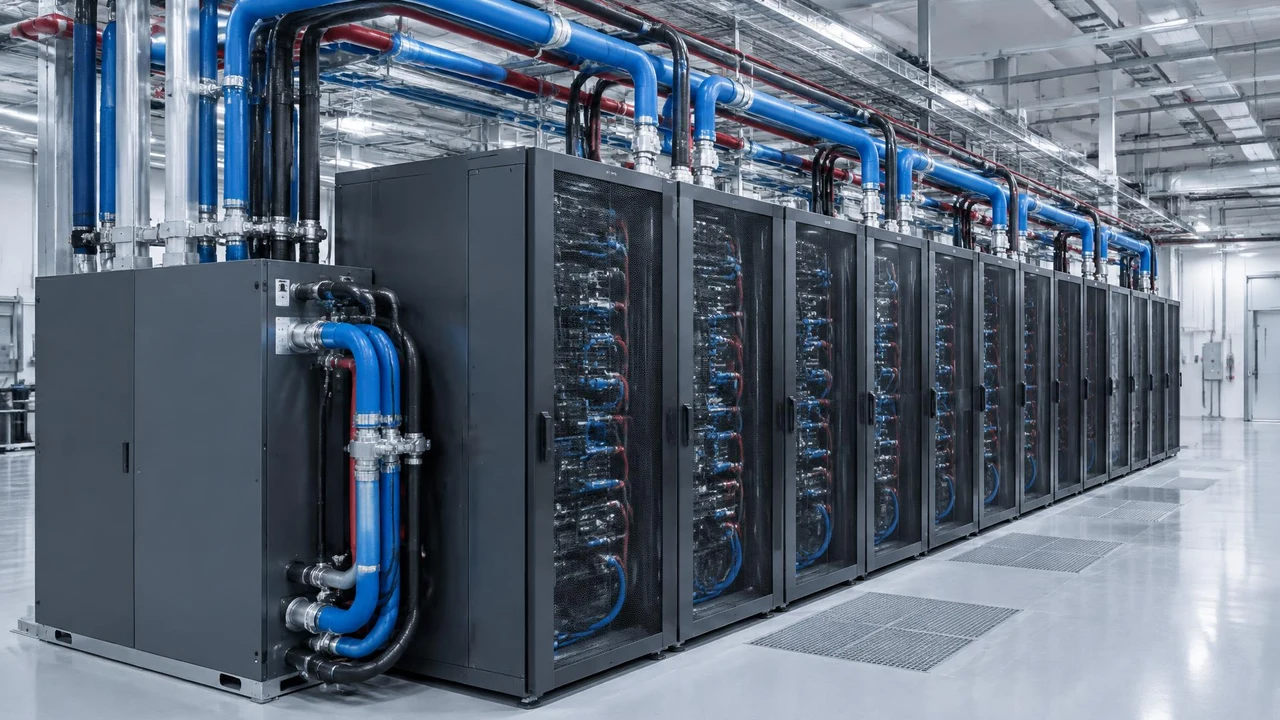
AI hardware has changed what a data hall has to do. A rack of modern accelerators can draw more power than a row of conventional servers, and almost all of that power leaves the rack as heat. Air alone struggles to carry it away. That is why the newest systems are designed for liquid from the start: NVIDIA describes its GB200 NVL72 as a "liquid-cooled, rack-scale" design (NVIDIA).
In the UAE the question is not only how to get heat out of the rack. It is how to reject that heat to an environment that is hot for much of the year, humid on the coast and dusty inland. This article sets out the three main approaches we design for, and the questions that decide between them.
Why density changes every design decision
In a conventional data center, cooling is a building service. In a high-density AI facility, it is part of the compute system. Rack power, the thermal chain and the electrical design are coupled: change one and the others move.
That is why we treat power and cooling as one interdependent system, with an upgrade path that anticipates changing rack architectures. The thermal chain, from the cold plate to the coolant distribution units (CDUs), the facility water loops, heat rejection and leak detection, is designed as a complete system, not as separate packages that meet at a contract boundary.
Option 1: Direct-to-chip liquid cooling
Direct-to-chip cooling runs liquid through cold plates mounted on the hottest components, usually the GPUs and CPUs. A CDU in or near the row separates the technology cooling loop that serves the racks from the facility water loop that carries heat away.
Where it fits: the current generation of rack-scale AI systems, which are increasingly designed around it.
What to check:
- the coolant supply temperature and flow the hardware vendor requires
- how the CDUs are made redundant and maintained without taking racks offline
- the share of rack heat still rejected to air, which the room design must handle
- leak detection and isolation at the rack, row and loop level
Option 2: Hydro cooling
Hydro cooling takes liquid further: the equipment is designed to be cooled by water circulating through the hardware itself, rather than by fans pulling air across it. It removes most of the air-handling load from the hall and can support very high densities in a compact footprint.
Where it fits: sites where density and space efficiency matter most, and where the hardware is supplied in a hydro-cooled configuration.
What to check:
- water quality and treatment, since the loop runs through the equipment
- serviceability: how individual units are swapped without draining a loop
- whether the chosen hardware platform is available in a hydro-cooled version
Option 3: Hybrid cooling
Most real deployments are hybrid. Liquid takes the heat from the processors, and air handles the remaining components, the networking gear and the room itself. A hybrid design can also be a transition strategy: a hall built today for mixed rack types, with a path to higher liquid fractions as the client's hardware roadmap moves.
Where it fits: mixed estates, phased deployments and clients who expect their rack architecture to change over the life of the facility.
What to check:
- the split between liquid and air heat load at launch and at the end of the roadmap
- whether the air side is sized for the worst case, not the average
- how the piping and CDU positions allow future racks to connect without rework
The desert problem: rejecting the heat
Whichever approach runs inside the hall, the heat still has to leave the site. This is where the UAE climate becomes the deciding factor. Every site we assess is reviewed against heat-rejection options, water strategy, ambient design conditions and dust exposure.
Three questions shape the answer:
- What ambient conditions must the plant handle? Heat rejection is designed for the hottest and most humid hours of the year, not the average. The design conditions you choose set the size of the plant.
- What is the water strategy? Evaporative approaches can be efficient but consume water. Dry coolers and closed loops save water but need more plant to reject the same heat on hot days. The right balance depends on the site's water supply and the client's targets.
- How will dust be managed? Inland sites face sand and dust that foul coils, filters and moving parts. Filtration, maintenance access and equipment selection have to account for it from the start.
Liquid cooling can help here. Liquid loops can often accept warmer coolant than an air-cooled hall needs, which gives the heat-rejection plant more room on hot days. How much room depends on what the hardware vendor allows, which is why the rack roadmap has to be fixed before the plant is sized.
Deciding before the design is fixed
The common mistake is to choose a cooling technology first and fit the site around it. We work the other way round: align ambient conditions, cooling technology and water strategy with the rack roadmap, then fix the design.
In practice that means answering, early:
- which hardware platforms the client expects to deploy, now and over the next refresh cycles
- the rack density at launch and at the end of the roadmap
- the water available on site, and the efficiency target
- the redundancy level, N+1 or 2N, that matches the workload's tolerance and the maintenance strategy
Get those right and the choice between direct-to-chip, hydro and hybrid usually follows. Get them wrong and the facility either cannot take the next generation of hardware or carries plant it never needed.
How we approach it
Neoverse designs, builds and hosts high-density facilities for AI compute in the UAE. Direct-to-chip, hydro and hybrid cooling are part of our design and construction capability, and every campus we plan is assessed for water and climate before it goes into a program.
Whether you need a build-to-suit facility engineered around your rack architecture, or a design and build on land you already control, the cooling strategy is set with you before the design is fixed.
Request a turnkey RFP and bring your rack roadmap. We will help you match the cooling to the hardware and the site.